Bluetooth headphones have to be one of the best inventions for audio lovers in a while. Sitting back and enjoying your favourite shows and movies without that damn wire flapping around and getting caught on everything – yep, we’re sold.
This guide will cover all aspects of how to watch TV with Bluetooth headphones. We’ll try to keep it general and dip into brand specific details when needed. Sit back relax and get ready for wire-free TV audio.
Quick answer: if your TV has Bluetooth, pair your headphones in its sound settings. If it doesn’t, plug a Bluetooth transmitter into the TV’s optical or headphone output. Choose a low-latency (aptX Low Latency) transmitter and headphones if you want the sound to stay in sync with the picture.
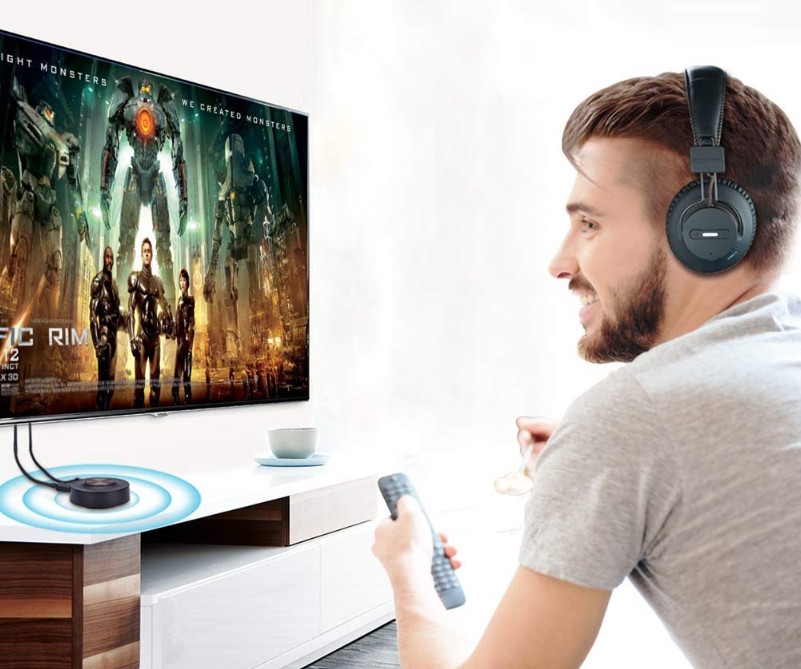
Headphones like the Avantree HT3189 (Amazon) come with a Bluetooth transmitter. Pic: Amazon
In This Guide
Is connecting your Bluetooth headphones to a TV difficult?
Jumping into the world of wireless TV listening not only lets you enjoy your TV and streaming stuff at a decent volume when everyone’s gone to bed, but the sound quality is also much better than what you’d hear through normal TV speakers.
Thankfully, getting it all set up and working is not difficult.
The hardest part is deciding HOW to do it.
There’s so many different options to pick from when you’re looking to get your TV audio via your headphones. Let’s look at each one in turn, along with the pros and cons of each.
Method 1 (Best method): Pick up a Bluetooth transmitter
Diving in to what is probably the fastest and easiest way to get your TV and wireless headphones to talk to each other – grabbing a 3rd party bluetooth transmitter, like this one on Amazon, to do the job for you.
These come in a few different shapes and sizes, from dongles to external little boxes. The idea’s the same. The transmitter sits between your TV and your headphones and handles the sending of data from your TV to the headphones.
They’re super-easy to setup and are pretty cheap. One of the best things is you can connect more than one pair of headphones wireless to them. As for connecting to your TV, you’ll normally get a choice (unless it’s a dongle – in which case it’s USB only). They’ll normally have a choice of AUX, optical at least. There’s a good one of the job on Amazon we’ve found for the job.
Pros: Simple way to use wireless headphones with TV. Connect 2 pairs at once easily.
Cons: You’ll have to order a ‘bit’ of the Interwebs
You can also get combined headphones and transmitter bundles that come all-in-one. One of the best ones you can get is the Avantree HT3189 (Available on Amazon UK). This wireless headphone set comes with the transmitter and features completely accurate lip syning. something that’s not as easy or straight forward as it sounds. They’re a decent price too and have good reviews on Amazon.
Method 2: Using your TV’s built in Bluetooth
So the obvious thing to do to get your TV and headphones to talk to each other via Bluetooth is TO USE the TV’s Bluetooth, right? Well the problem is that not all TV’s have Bluetooth yet. Sounds crazy, but it’s true.
Check your TV has Bluetooth in the TV’s settings menu, or the manual, or the specs online. If your TV does have Bluetooth, it’s simple a case of pairing them together. Put the headphones into pairing mode and go to the Bluetooth settings on your TV. It’s that simple.
Pros: Quick and easy to do. Stable connection and minimal lag.
Cons: Your TV might not have Bluetooth (lots don’t)
Method 3: Use the 3.5mm jack on your streaming service remote
Love your streaming services? So do we. And who’d have thought they’d be able to solve the problem of how to use headphones with TV programs? Some streaming hardware, like Apple TV and Amazon Fire have a handy port on the side of the remote where you can plug in your headphones.
OK this is CHEATING! This involves wired headphones, or using a cable with your headphones. As such, it’s definitely not a recommended method, but we thought we’d post it anyway as it does work pretty well!
Pros: If you’ve got a cable, and the right streaming hardware, go for it.
Cons: You’ve still got a wire, damn it!
Method 4: Using the streaming feature of Amazon or Apple
If you’ve got something like Apple TV, or Amazon’s streaming service, chances are the box will allow you to watch TV with wireless headphones. Simply pair the box with your headphones and you’ll be able to enjoy your TV shows and movies through your Bluetooth headphones.
Pros: Quick and easy. No extra hardware.
Cons: It only covers your streaming service, not general audio from the TV and other things like your Sky box.
Method 5: Use the Bluetooth on your TV soundbar
Soundbars are wonderful things. We’ve written a fair bit about them here on Audio Punch. Not only are they a fantastic way to replace your TV’s flat, tinny sound with a rich cinema-esque sound, but they can also SEND Bluetooth audio to your headphones.
If you’ve got a soundbar sitting there, you’ve got a good chance this will be a good option for streaming to your headphones. Of course, you’ll either need to have a soundbar or splash out on one.
Pros: Easy way to watch TV with headphones.
Cons: You’ll need a soundbar and good ones don’t come cheap.
Why is my Bluetooth headphone sound delayed?
Bluetooth takes a little time to compress and send audio. That delay is called latency, and with standard Bluetooth it can be around a fifth of a second or more. On music it isn’t noticeable, but on TV it means voices lag slightly behind lips. To fix it:
- Use low latency Bluetooth. The transmitter and the headphones both need to support aptX Low Latency (or a similar low-latency mode) for the delay to shrink to a level you won’t notice.
- Adjust the TV’s lip-sync setting. Many TVs have an audio delay or lip-sync option in the sound menu. Adjust it until speech and picture match.
- Use optical rather than the headphone output on the TV, where possible, since it usually carries a cleaner signal and gives the transmitter more flexibility.
- Avoid wireless from a streaming app on a phone if you’re watching on the TV. Streaming to a phone and then to headphones adds extra delay.
Step by step: pairing with a TV that has Bluetooth
Menus vary by brand and model, but the process is the same.
- Put your headphones into pairing mode. This is usually a long press on the power or Bluetooth button until a light flashes.
- On the TV, open Settings and look for Sound or Audio, then Sound Output, Speaker Settings, or Bluetooth.
- Choose Bluetooth audio or Add new device, and select your headphones when they appear.
- Set the sound output to your headphones, and check that the TV speakers are muted if you don’t want both.
- Test with some speech and adjust the lip-sync setting if needed.
Some TVs only allow one Bluetooth audio device at a time, and some only work with headphones of the same brand, so check your TV’s manual if it doesn’t work.
Step by step: using a Bluetooth transmitter
- Connect the transmitter to the TV’s optical output (or the 3.5mm headphone output if there’s no optical). Power it from a USB port on the TV or a USB charger.
- Set the TV’s audio output to optical or headphone out if needed, and the audio format to PCM if you hear no sound.
- Put the headphones into pairing mode and switch on the transmitter’s pairing. They should connect within a few seconds.
- Test the sound and lip-sync, and adjust the TV’s settings if necessary.
Once paired, the headphones normally reconnect automatically when both are switched on.
Which method should you choose?
- You just want it to work with any TV and headphones: a Bluetooth transmitter (Method 1).
- Your TV has Bluetooth and you’re happy with a basic setup: the TV’s built-in Bluetooth (Method 2).
- You only watch streaming apps: the Bluetooth settings on your Fire TV or Apple TV (Method 4).
- You have a soundbar with headphone Bluetooth: use it (Method 5).
- You want the most reliable and cheapest option: a wired connection (Method 3), where practical.
Fixing common problems
- Sound cuts out or stutters: keep the headphones within a few metres of the transmitter or TV, without walls or metal in between. Move the transmitter away from Wi-Fi routers and other wireless devices.
- Volume is too low or too high: some TVs fix the volume of the Bluetooth output. Adjust volume on the headphones, and check the TV’s volume setting.
- TV speakers still play as well: mute them in the audio settings, or change the sound output setting.
- Headphones connect to your phone instead: turn Bluetooth off on your phone, or unpair, so the headphones connect to the TV.
- Won’t pair at all: reset the headphones to factory settings, and make sure they’re in pairing mode (not just connected to another device).
Wireless TV headphones for hearing difficulties
If you or someone at home finds it hard to follow TV speech, dedicated wireless TV headphones are worth a look. Many use their own transmitter and a radio or infrared link, rather than Bluetooth, which gives a delay-free connection and a range that can cover a whole room. Some also have speech enhancement to lift dialogue. Choose one with a comfortable fit and clear speech mode, and make sure the transmitter connects to your TV’s output.
Using headphones safely
Long TV sessions with headphones can lead you to turn the volume up more than you realise. Keep the level moderate, take breaks, and remember you might not hear the doorbell, alarms or people talking. Headphones with a transparency mode, or a lower volume in the evening, can help.
Watching TV with Bluetooth headphones FAQ
Can two people listen with different headphones at once?
Yes, if you use a transmitter that supports two headphones at the same time, like the dual adaptor mentioned above. Check that it supports “dual link” and that both headphones work with it.
Do all Bluetooth headphones work with a TV?
Almost all, but some TVs restrict which ones can pair, and cheap headphones can have more lag. If in doubt, use a transmitter.
Will it work with Sky, Virgin or a Freeview box?
Set-top boxes usually don’t send audio directly to Bluetooth headphones. The simplest way is to send the TV’s audio out (optical or headphone output) to a transmitter, so all sources go through the same route.
Is it better to use noise cancelling headphones for TV?
Noise cancelling can help in a noisy household, but you may hear less of what’s going on around you. Choose it if you want to focus, and consider a transparency mode if you need to hear the room.